Grow without growing your team, your costs or your risk.
Room to grow is a free suite of business analysis tools. See what’s at stake, what to tackle first, what to budget and where it’s all heading, before you spend a dollar.
What you get
- A clear picture of what’s at stake. What growing the way you work today costs in people, money and risk, and what it takes to get it right.
- A roadmap for the problems. Which one to tackle first, which come next, and whether your people and your leadership are ready for it.
- A budget that pays back. What a realistic investment looks like and the upper limit, and how government incentives such as the R&D tax offset stretch it further.
- The long-term picture. Where the business is heading, how it keeps compounding, and what it’s worth when it no longer depends on a few key people.
How it works
- Start a tool. No sign-up. Most take five to ten minutes, and you see your result straight away.
- Save it to a free profile. Name your company or project and add your email. That opens the other tools, and you can add more companies or projects later.
- Watch the picture build. Which process to build first, whether your people will adopt it, what the problem costs today, and what keeps holding the business back.
Start now, no sign-up
Pick a tool to start
Most take five to ten minutes. You'll see your result straight away, then save it to a free profile if you want to keep it and open the other tools.
Already have a profile? Log in.
Grow significantly without growing your team and your risk at the same rate. See what that's worth, and what you can invest to get there.
Start →Score each problem area and find the right first build.
Start →For experts with know-how worth packaging. Test whether your idea could become a product people pay for.
Start →An honest self-assessment of the leadership behaviours that decide whether a capability build succeeds.
Start →Surface the know-how sitting in people's heads and spreadsheets, and how exposed it is.
Start →How transferable your business is today, where you are on the journey, and what playing the long game means for you.
Start →Will your people adopt what you build? Find the adoption risks for each process.
Start →Custom, off-the-shelf or hybrid? Decide based on where your competitive advantage actually lives.
Start →Set the baseline, put a cost on the problem, and define the result your first phase must prove.
Start →For builds already underway: catch the signals that momentum is fading, or that you're building too fast.
Start →Choose your first build: weigh your top candidates on value, strategy and what you can achieve.
Worked through with Redgum
Four of the book’s tools are where the picture turns into a plan. They work best as a working session together. Everything in your account comes with you, so we start from your answers, not a blank page.
The examples below are for a fictional business, Smith Earthworks.
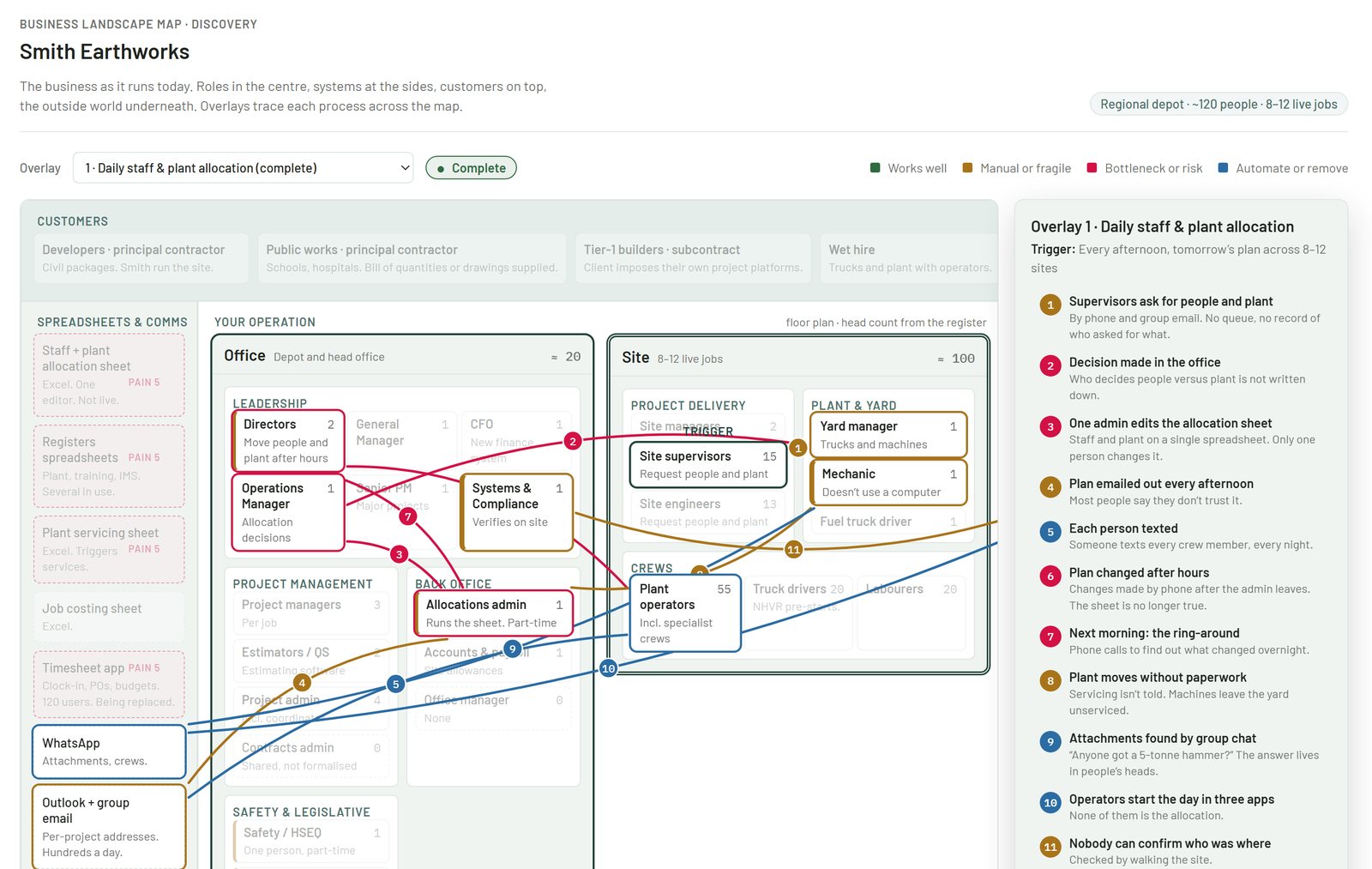
Business Landscape Map
See how your business actually works, not how the org chart says it does. You walk away with one picture your leadership team agrees on, every step where time and money leak out, and your single points of failure named. About the Business Landscape Map.
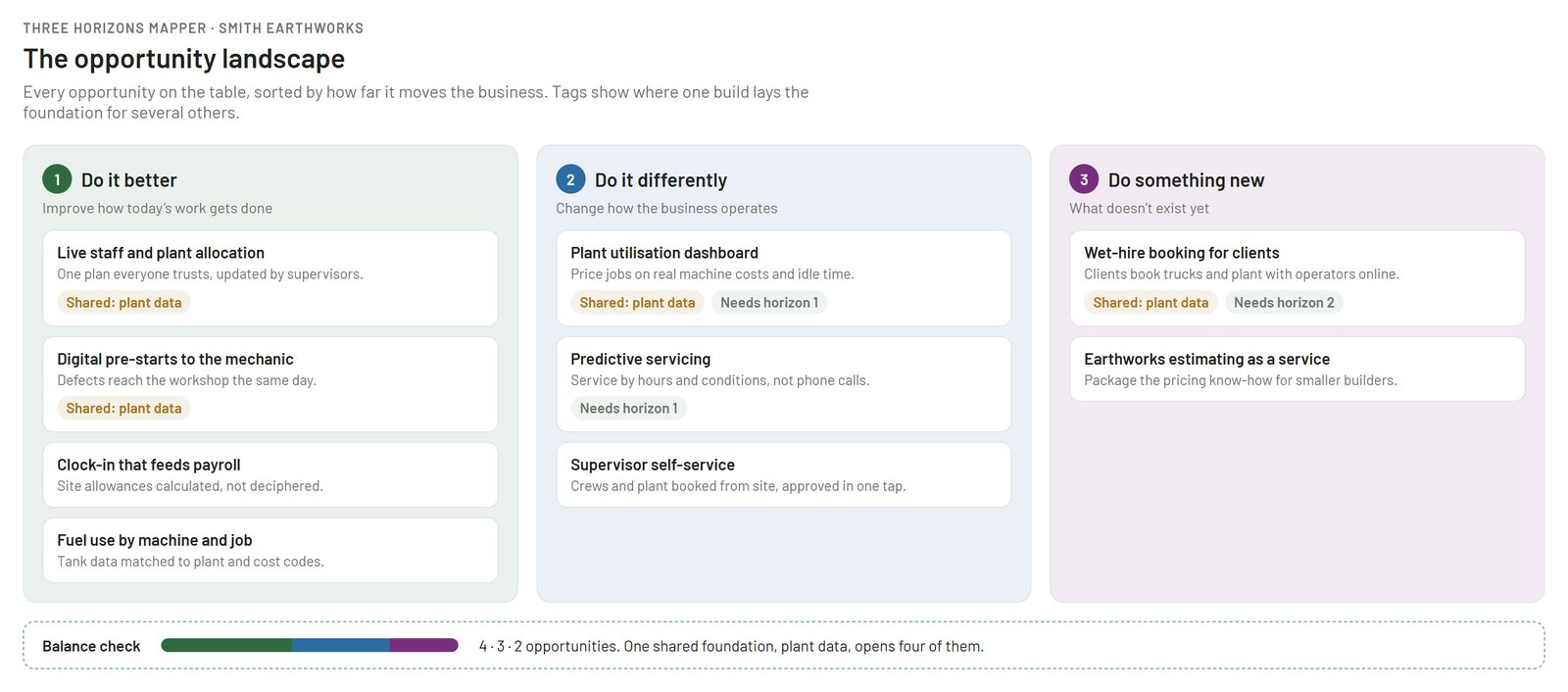
Three Horizons Mapper
Find the opportunities you’re not looking for yet. You walk away with a longer, better list, sorted into doing things better, doing them differently, and things that don’t exist yet. About the Three Horizons Mapper.
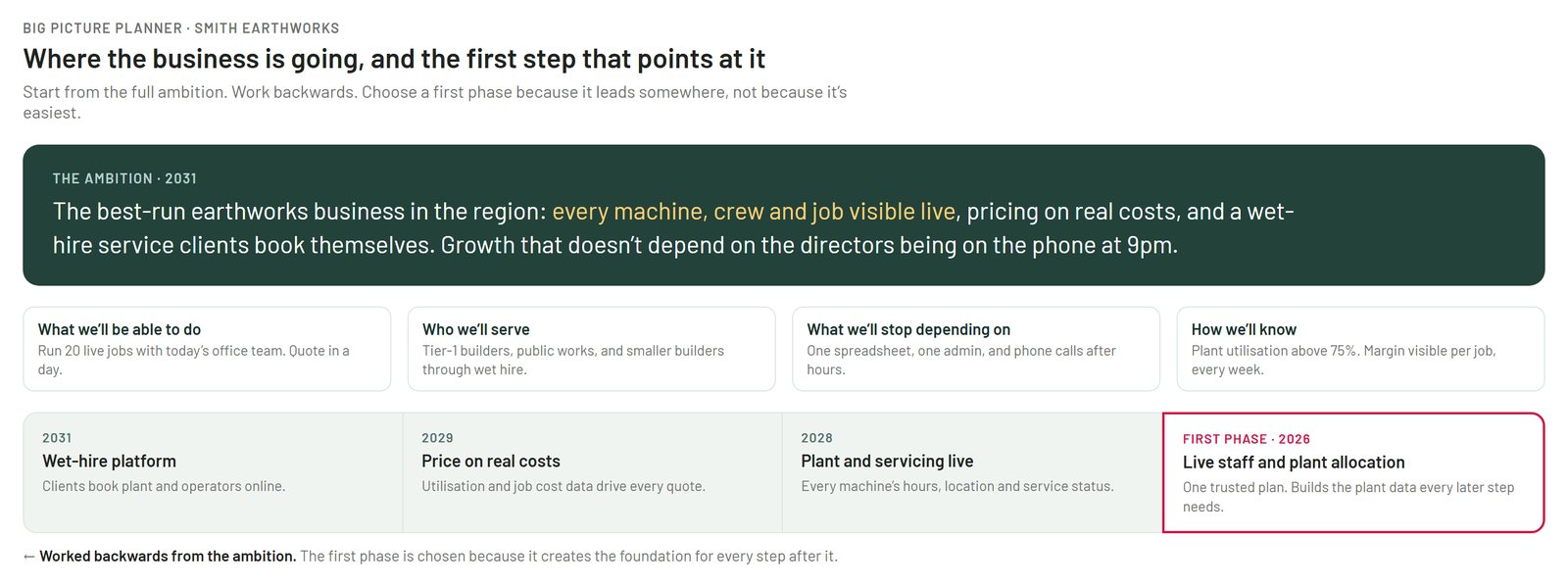
Big Picture Planner
Decide what you’re really building towards, then make sure the first step points at it. You walk away with the ambition in your words, and the story to take to your partners, board or bank. About the Big Picture Planner.
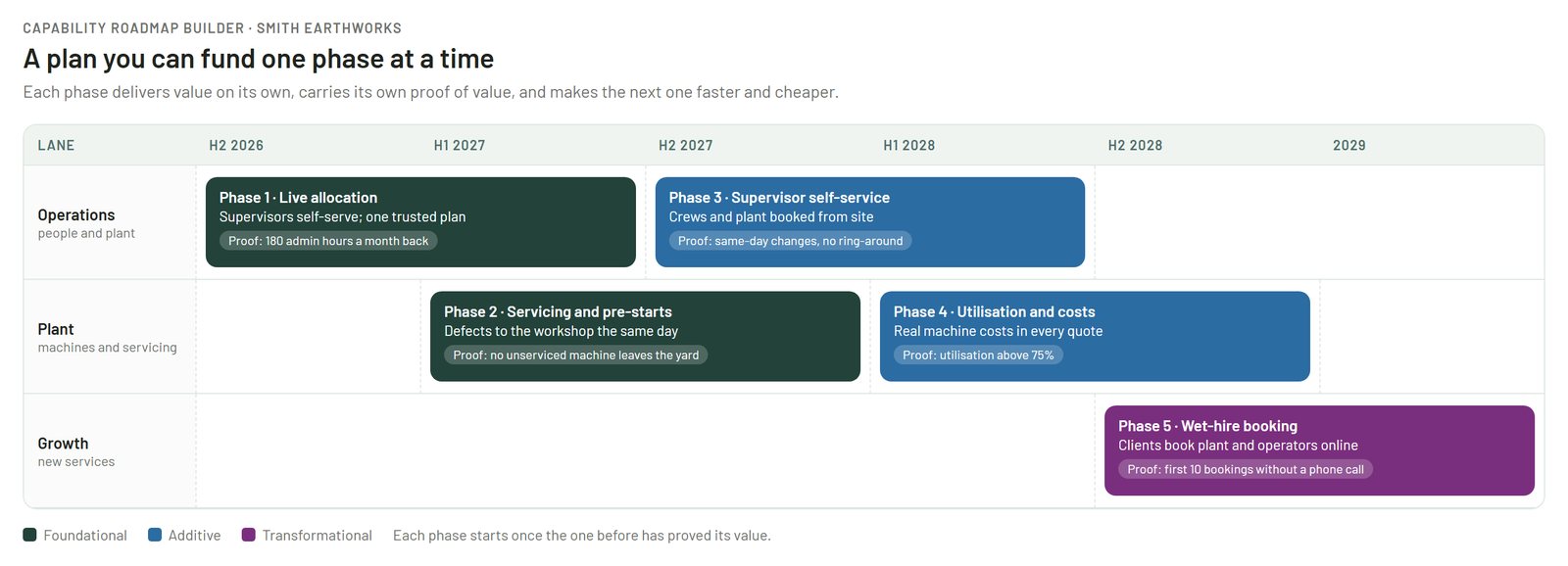
Capability Roadmap Builder
Turn everything in your account into a plan you can fund one phase at a time. You walk away with a 12 to 36 month roadmap, with a proof of value and budget range for every phase. About the Capability Roadmap Builder.
Start with Which system should you build first? →